

assessing alternative scenarios of development
Our remit
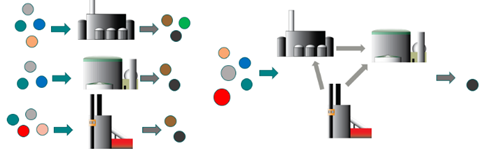
The clients (Tillväxt Gotland and Region Gotland) wanted to develop a new industrial park based on industrial symbiosis (IS). Industrial symbiosis is a captivating concept that seeks to emulate nature, where waste resources or by-products are utilized by other entities. The outcome is an network exchanging, water, energy and materials.
(This project was conducted at the Swedish Environmental Research Institute, and led by Steve Harris of Godolphin Sustainability Services)
The Approach
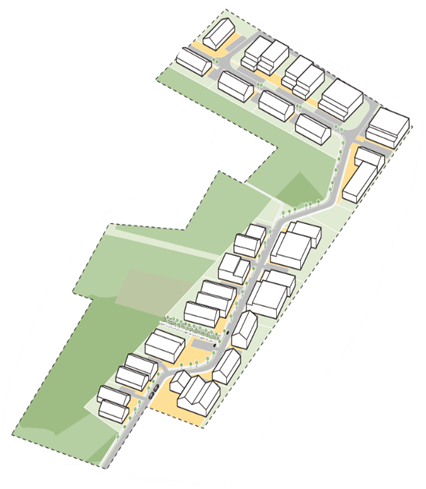
The aim of our study was to identify the most appropriate development strategy to maximise industrial symbiosis, resource efficient production and the sustainability outcomes of the park. The chosen site is 2 km north of Visby (on the island of Gotland, Sweden), adjacent to the main airport and is 20 hectares of land.
Development of industrial symbiosis (exchanges between companies) on a greenfield site with no current residents is an enormous challenge. Well known examples of industrial symbiosis (e.g. Kalundborg, Denmark and Kwinana, Western Australia) attribute their success to existing companies developing collaborative relationships that help identify potential synergies between the respective companies.
To help identify potential pathways forward (and identify the most strategic development pathway), the project focused on three tasks:
- Review of industrial symbiosis - a literature review and examination of current examples and academic understanding.
- Regional SWOT analysis - to understand the strengths , weaknesses and opportunities for the island of Gotland.
- Assessment of development strategies/scenarios - sustainability assessment of scenarios using a combination of life cycle assessment and socio-economic assessment.
Main findings
The main strengths of Gotland that can provide the foundations for strategic development include agriculture, tourism, the food and beverage industry, good location and strong potential for renewable energy development and related industries. Three themes/scenarios were developed to represent variations in possible strategic approaches to GISP development which build on these strengths:
- Food, Tourism and Agriculture (FAT) – representing an approach that builds on existing strengths and skills capacity of the island. This theme therefore focuses on a symbiotic network with local food and beverages, brewery, bakery, shops and restaurants aimed at connoisseurs and tourism.
- Small and Medium-sized Enterprises (SME) – represents a traditional commercial focus where SME’s are encouraged to locate to fill land on a willing to pay rent basis. The modelled theme includes a park consisting of a sign’s & graphics producer, an office and conference centre, an electric motorbike producer, wool production, textiles, utility company and a facility for reuse of demolition by-products. A heat network exists in the park to supply and reuse waste heat.
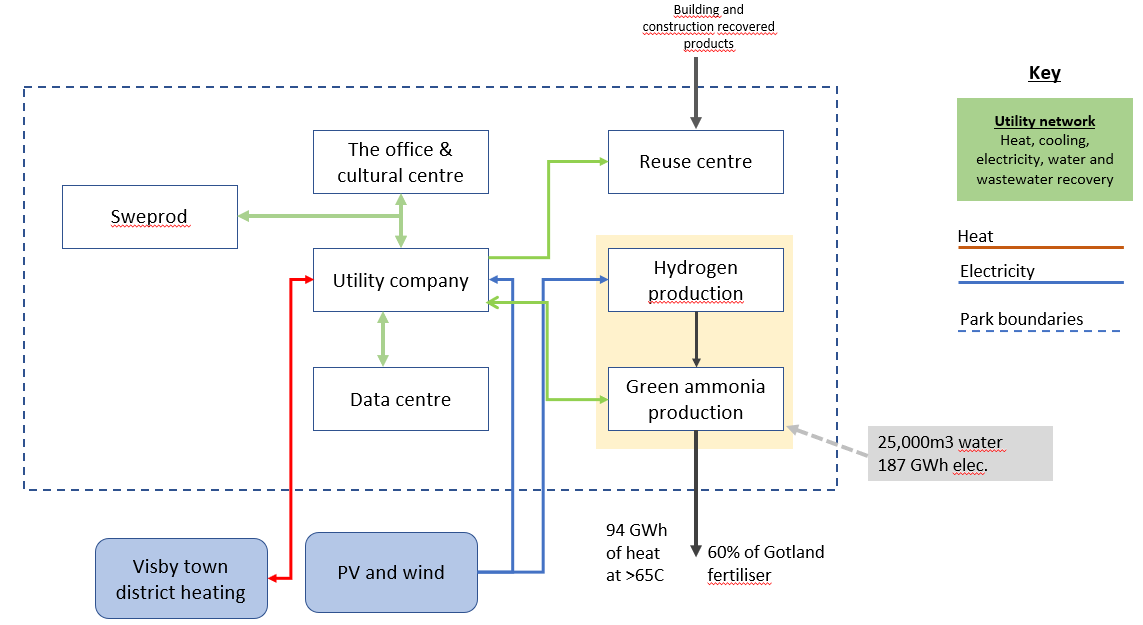
- Industrial Symbiosis and Circular Economy integration theme (IS-CE) – represents a scenario where industries are encouraged to locate at GISP that form supply/customer or industrial symbiosis with existing local companies and entities; and/or they support the development of a circular economy on the island. The example for this theme centres around the utilisation of excess renewable energy to produce hydrogen and green ammonia. The green ammonia is used in local agriculture in place of fossil-based fertiliser. Other entities in the theme included a sign’s producer, an office and a conference centre, and a facility for reuse of demolition by-products.
Figure 1: The integrated energy theme
The sustainability assessment highlighted a large variation in potential sustainability outcomes for different approaches. The most appealing is the IS-CE which represents a circular economy (CE) approach, going beyond sustainable production to consider also sustainable consumption. For instance, assessment of this theme demonstrated a potential to offset Greenhouse Gas (GHG) emissions by replacing fossil fuel-based fertilisers with those produced from renewable energy and hydrogen. Although such a company may not locate at GISP, this highlights the potential of encouraging certain companies that can produce sustainable products, to locate at the park.
Figure 2: Climate change for the operation of the three potential themes per year.
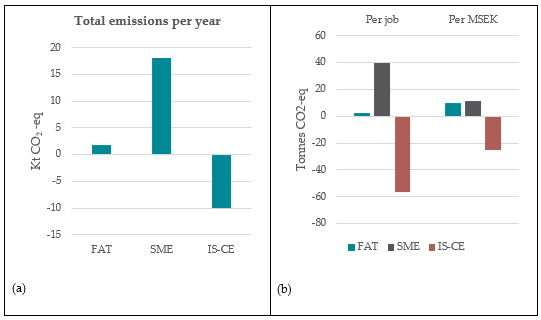
(a) Total CO2-eq emissions per year, (b) GHG emissions/year/job and GHG emissions/year/million Swedish Kroner (MSEK)
The Outcome
The project culminated in a strategic roadmap consisting of three stages: 1. Strategic vision, 2. Implementation and 3. Operation. Developing a strategic vision is a designed as a valuable process to ensure the associated stakeholders (Region Gotland, Tillväxt Gotland, planners, companies and developers) understand the strategic sustainability implications of developing the park based on the different approaches. Therefore, it is a critical component to ensure that the stakeholders develop a clear approach to capitalise on the opportunity to reduce climate impacts, and maximise the sustainability outcomes of GISP.
The park is a critical opportunity to limit the island of Gotland’s impact for generations to come. by focussing on products that offset emissions instead of contributing to them. For example, one of the largest contributors to GHG emissions on Gotland is derived from the agricultural use of fertiliser which adds almost 100,000 tCO2-eq to Gotland’s GHG footprint each year.
(This project was conducted at the Swedish Environmental Research Institute, and led by Steve Harris of Godolphin Sustainability Services)